
Albert Hall Museum Jaipur: The oldest museum in Rajasthan
Standing proudly in the lush greenery of Ram Niwas Garden, the Albert Hall Museum is not just Rajasthan's oldest museum, it is a magnificent blend of art, history, and architecture. Often called the Royal Albert Hall of Jaipur, this iconic landmark is one of the most photographed monuments in the Pink City. Whether you are a history buff, an art lover, or simply looking for a unique experience, the Albert Museum Jaipur promises an unforgettable journey through centuries of craftsmanship.
This complete guide covers every question: albert hall jaipur timings, albert hall museum ticket price, albert hall museum tickets booking, the famous night albert hall jaipur illumination, how to capture stunning albert hall museum photos, and what to see inside. Let's explore the Albert Hall Jaipur.
Albert Hall Museum – Overview & Quick Facts
| Detail | Information |
|---|---|
| Official Name | Albert Hall Museum (also Government Central Museum) |
| Location | Ram Niwas Garden, Ashok Nagar, Jaipur, Rajasthan – 302004 |
| Built Between | 1876 – 1887 (foundation laid in 1876, completed in 1887) |
| Architect | Sir Samuel Swinton Jacob (assisted by Mir Tujumool Hoosain) |
| Commissioned By | Maharaja Sawai Ram Singh II |
| Named After | King Edward VII (then Prince Albert) |
| Architectural Style | Indo-Saracenic (fusion of Rajput, Mughal and Gothic elements) |
| Famous For | Egyptian mummy (over 2,300 years old), miniature paintings, pottery, weaponry |
| Total Galleries | 16 |
| Night View | Illuminated with colorful lights every evening |
| Sound & Light Show | Yes (50 minutes, Hindi/English) |
Did you know? The Albert Hall Museum was modelled after the Victoria and Albert Museum in London. It was originally conceived as a concert hall but later converted into a museum to display local craftsmanship.
History of Albert Hall Museum – From a Public Hall to a Treasure Trove
The story of Albert Hall Museum Jaipur begins in 1876 when the foundation stone was laid during the visit of Albert Edward (King Edward VII), the Prince of Wales. The building was initially intended to serve as a public hall for concerts, gatherings, and social events. However, its purpose shifted after a suggestion by Dr. Thomas Holbein Hendley, the then resident surgeon of Jaipur.
Hendley proposed that the building be used to display the exquisite craftsmanship of local artisans – a way to encourage and preserve traditional arts. Maharaja Sawai Madho Singh II supported this idea, and in 1881, a small museum was opened within the premises. The construction of the current building was finally completed in 1887, and it was named Albert Hall in memory of the Prince of Wales.
The museum quickly became a repository of Rajasthan's artistic heritage. Over the decades, it has acquired thousands of artefacts – from miniature paintings and ancient coins to weaponry, textiles, and even an Egyptian mummy. In 1968, it was renamed Albert Hall Museum and continues to be a major attraction for tourists and researchers alike.
Architecture A Masterpiece of Indo-Saracenic Design
The Albert Hall Jaipur is one of the finest examples of Indo-Saracenic architecture, a revival style used by the British in India during the 19th century. This style blended Islamic, Hindu, and Gothic elements, creating buildings that were both majestic and functional.
Key architectural features:
Red and cream sandstone facade – The building is constructed from locally sourced stone, giving it a warm, earthy tone that glows in the evening light.
Ornate chhatris (domed pavilions) – Traditional Rajasthani elements crown the building, adding a regal touch.
Decorative arches and pillars – The entrance features intricate jali (lattice) work and carved columns.
Towering domes and minarets – A blend of Mughal and Gothic influences.
Beautiful courtyard – The inner courtyard is surrounded by arched walkways, creating a peaceful space for visitors.
Intricate ceiling paintings – The interiors are adorned with murals depicting ancient civilizations (Babylonian, Greek, Chinese, etc.).
Photography note: The best time for albert hall museum photos from outside is late afternoon (3–5 PM) when the sun's golden rays hit the facade. The museum is also beautifully illuminated at night – a sight not to be missed.
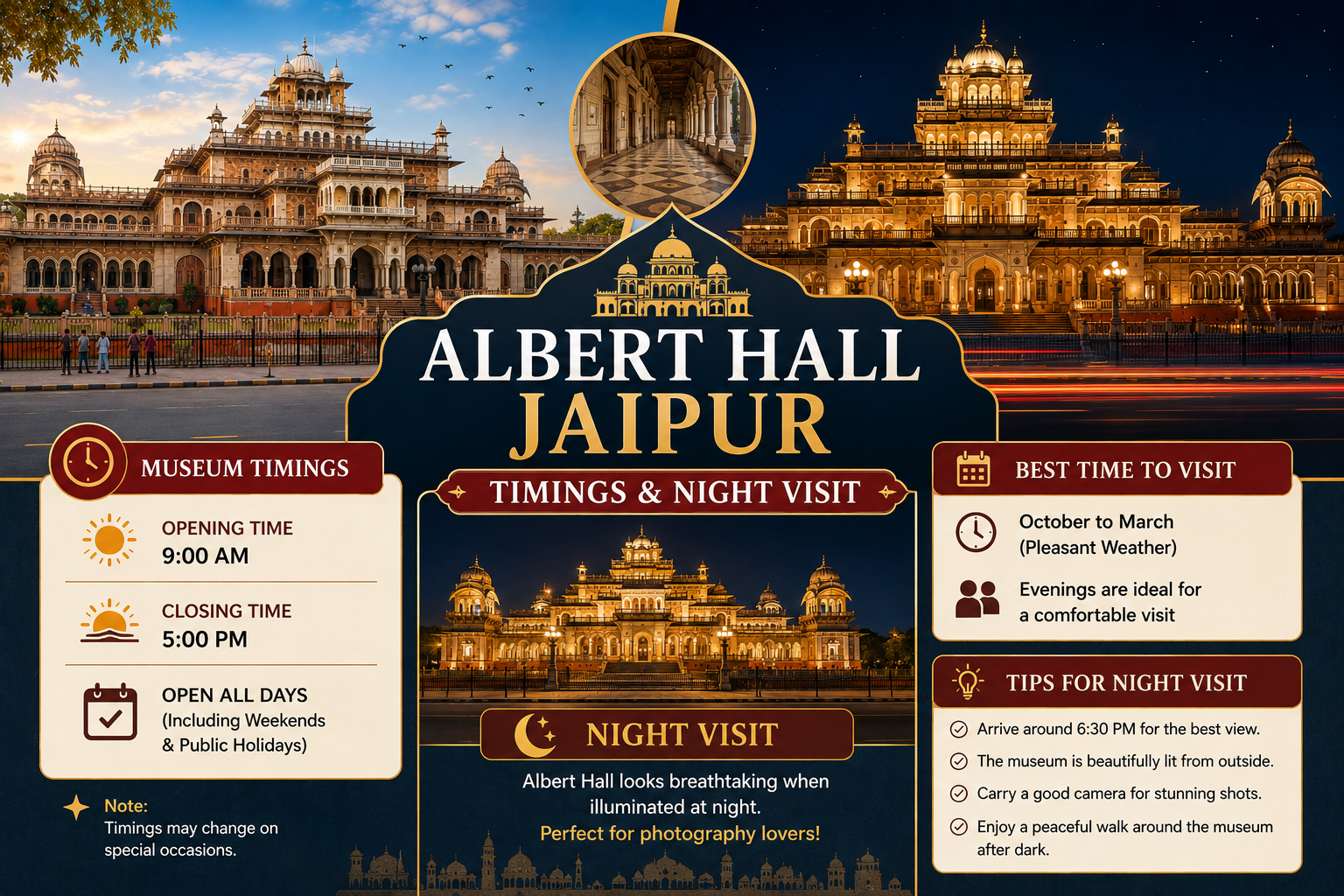
Albert Hall Jaipur Timings & Night Visit
Albert Hall Jaipur timings are convenient for visitors, with both day and night options.
| Activity | Timings | Notes |
|---|---|---|
| Museum Day Hours | 9:00 AM – 9:00 PM | Open seven days a week |
| Last Entry | 8:30 PM (approximately) | Ticket counter closes at 8:00 PM? Better to arrive by 7 PM for evening visit. |
| Sound & Light Show | 7:00 PM – 8:00 PM | 50-minute show; separate ticket |
| Night Illumination | After sunset (visible from outside) | The building is lit with colourful lights; no entry after 9 PM |
| Closed for Maintenance | Last Tuesday of each month (Oct–Mar) & Last Monday (Apr–Sep) | Check before planning |
Night Albert Hall Jaipur – Is It Worth It?
Yes! The night albert hall jaipur experience is magical. After sunset, the museum facade is bathed in a sequence of colorful lights – purple, pink, blue, orange – creating a stunning spectacle. The illuminated building is a favorite subject for photographers. However, note that the interior galleries close by 9:00 PM, so you cannot explore the exhibits at night unless you enter earlier. But you can stroll around Ram Niwas Garden and admire the lit facade.
Best time for night photos: Between 7:30 PM and 8:30 PM – the lights are at their brightest, and the crowd is thinner.
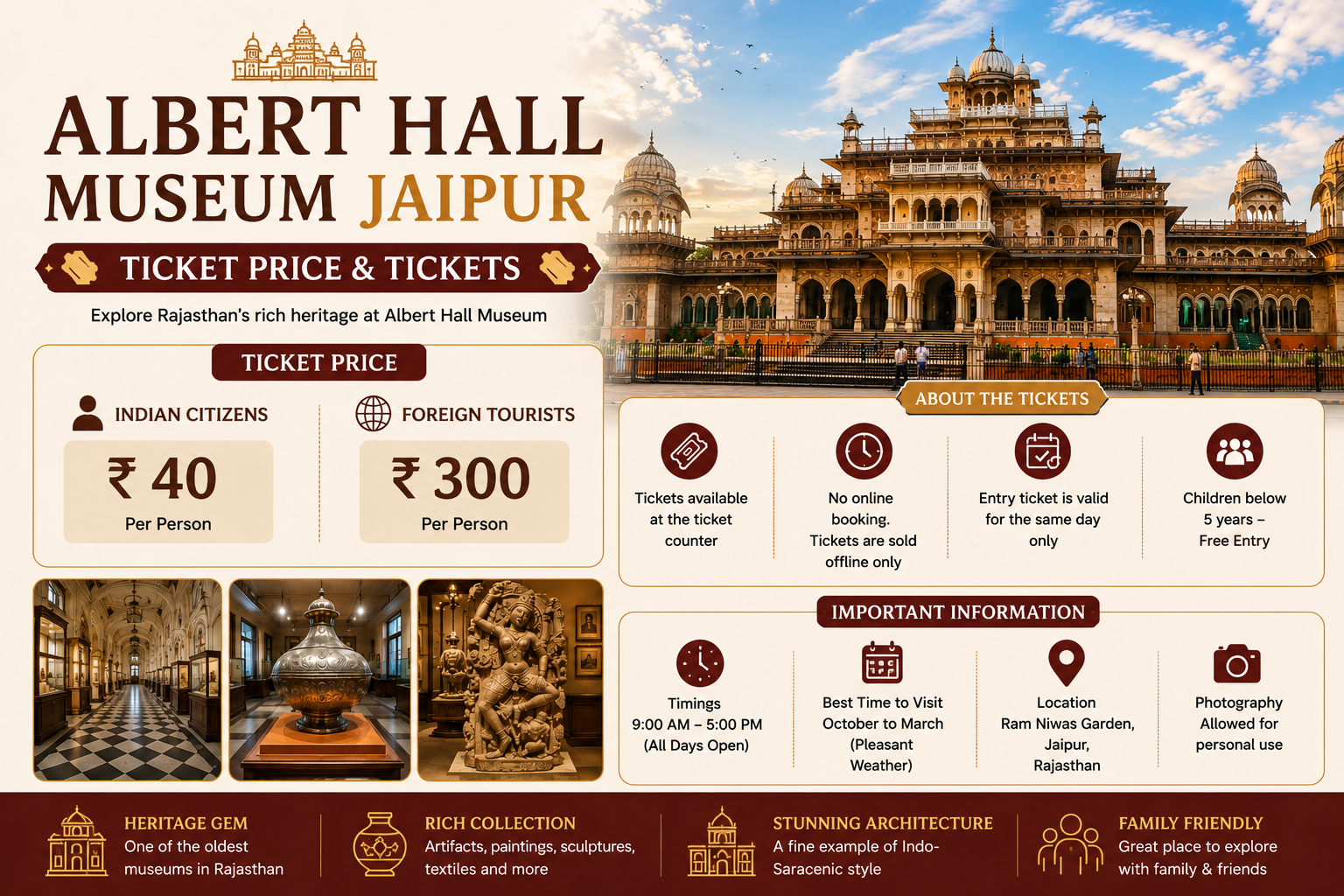
Albert Hall Museum Ticket Price & Tickets
The albert hall museum ticket price varies by nationality and whether you purchase a single ticket or a composite ticket (which covers multiple Jaipur monuments).
General Entry Ticket (available at the museum counter)
| Visitor Category | Ticket Price (₹) |
|---|---|
| Indian Citizens | ₹40 (varies by source; official RTDC site |
| Indian Students (with valid ID) | ₹20 |
| Foreign Tourists | ₹300 |
| Foreign Students | ₹150 |
| Children below 7 years | Free |
Composite Entry Ticket (valid for 2 days)
This ticket covers Albert Hall Museum, Amber Fort Jaipur, Hawa Mahal Jaipur, Jantar Mantar Jaipur, Nahargarh Fort Jaipur, Vidyadhar Garden, Sisodia Rani Garden, and Isarlat (Sargasooli) . It is available at the counters of these monuments.
| Visitor Category | Composite Ticket Price (₹) |
|---|---|
| Indian Citizens | ₹420 |
| Indian Students | ₹110 |
| Foreign Tourists | ₹1,100 |
| Foreign Students | ₹550 |
Free Entry Days (for all visitors)
30th March – Rajasthan Diwas (Rajasthan Day)
18th April – World Heritage Day
18th May – World Museum Day
27th September – World Tourism Day
Additional Charges
| Item | Fee (₹) |
|---|---|
| Still Camera (non‑professional) | ₹50 |
| Video Camera | ₹100 |
| Sound & Light Show | ₹100 per person |
Pro tip: If you plan to visit multiple monuments, the composite ticket offers excellent value. For example, a single visit to Albert Hall (₹40) + Amber Fort (₹100) + Jantar Mantar (₹50) + Nahargarh (₹50) already totals ₹250, while the composite ticket for Indians is ₹420 – you also get Hawa Mahal and other gardens included.
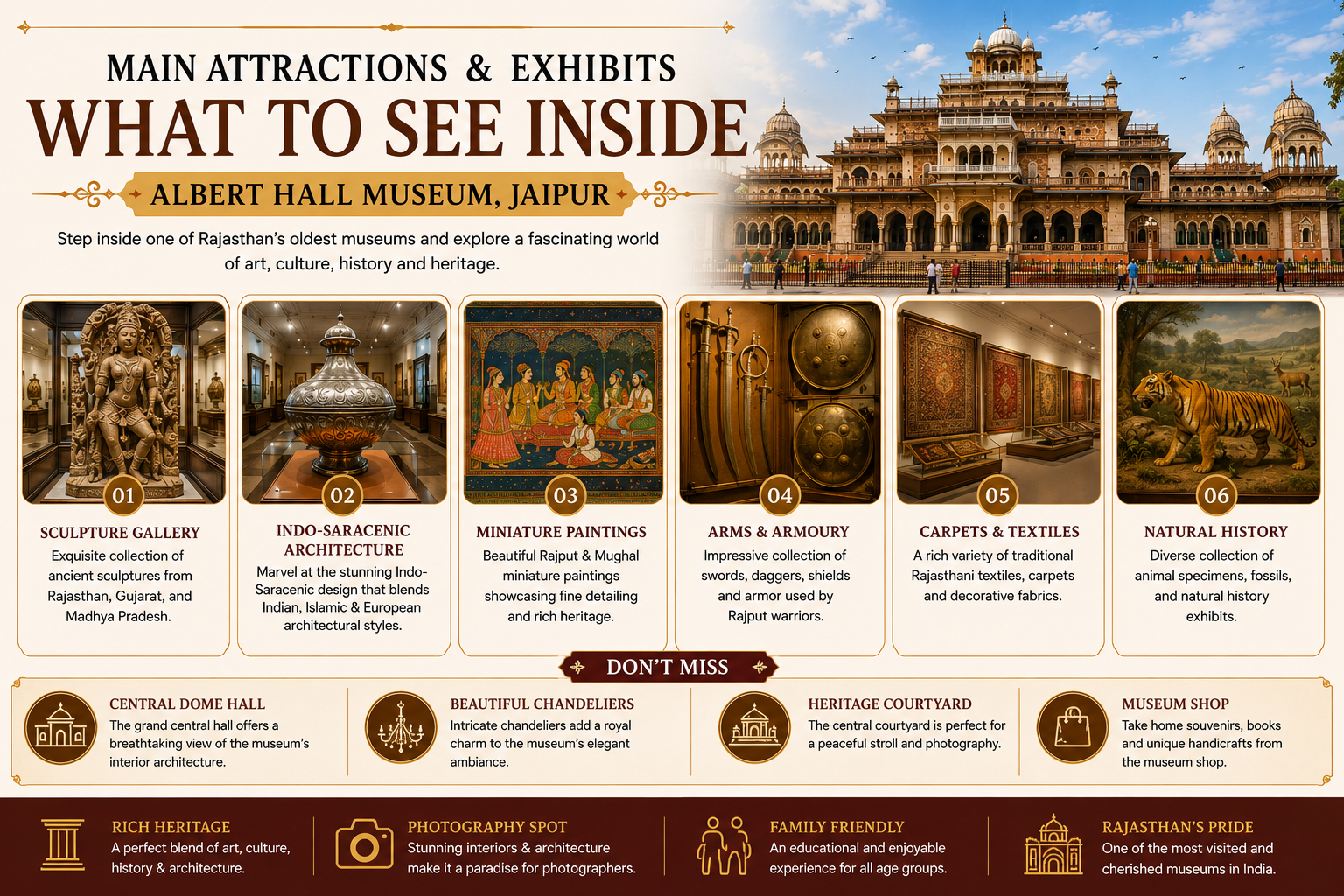
Main Attractions & Exhibits – What to See Inside
The Albert Museum Jaipur houses 16 galleries spread across two floors. Here are the absolute must‑see exhibits, perfect for albert hall museum photos.
1. Egyptian Mummy – The Star Attraction
The museum's most famous exhibit is the 2,300‑year‑old Egyptian mummy of a woman named Tutu. It was acquired from Cairo and is one of the few genuine Egyptian mummies on display in India. The mummy is enclosed in a glass case, and an X‑ray performed in 2011 confirmed that the bones are still intact. A panel nearby explains the mummification process.
2. Miniature Paintings Gallery
This gallery showcases exquisite Rajasthani miniature paintings from various schools (Jaipur, Kishangarh, Bundi, etc.). The vibrant colors and intricate details depict court scenes, religious stories, and royal portraits.
3. Pottery & Ceramics
A stunning collection of blue pottery from Jaipur, glazed vases, terracotta bowls, and Arabic-influenced designs. Each piece is unique and beautifully preserved.
4. Arms & Weapons
An impressive array of antique weapons – swords, daggers (including a double‑bladed katar), spears, shields, and pistols. Some date back to the 15th century and were used by Rajput warriors.
5. Jewellery & Textiles
Traditional Rajasthani jewellery (kundan, meenakari, lac bangles) and textiles featuring gota work, bandhani, and Sanganeri prints. Also on display are royal costumes and embroidered shawls.
6. Carpet Gallery
Exquisite hand‑woven carpets from the Mughal and Rajput eras, showing intricate patterns and fine craftsmanship.
7. Musical Instruments
Ancient instruments like the sitar, sarangi, pakhawaj, and folk instruments used in traditional Rajasthani music.
8. Murals & Ceiling Paintings
The museum's walls and ceilings are adorned with murals depicting ancient civilizations (Babylonian, Greek, Chinese, Egyptian) – a unique feature that sets Albert Hall apart from other museums.
9. Wax Statues & Figurines
Lifelike wax statues of Rajput kings, soldiers, and commoners, created to depict historical scenes.
10. The Horse Puzzle (Curiosity)
A fascinating piece – a horse made up of interlocking human faces. It is a conversation starter and a testament to the creativity of local artisans.
Time required: A thorough visit takes 2–3 hours. If you attend the sound and light show, add another hour.
Sound & Light Show at Albert Hall Museum
The sound and light show at Albert Hall Museum is a 50‑minute spectacle that narrates the history of Jaipur, its founder Maharaja Sawai Jai Singh II, and the building of the museum. The show uses dramatic lighting projections on the museum's facade and courtyards, accompanied by engaging narration.
| Show Detail | Information |
|---|---|
| Timing | 7:00 PM – 8:00 PM (nightly) |
| Language | Hindi and English (alternate days – check at the counter) |
| Ticket Price | ₹100 per person |
| Where to Buy | At the museum ticket counter |
| Duration | 50 minutes |
| Seating | Open courtyard (first come, first served) |
Is it worth attending? Yes, especially for first‑time visitors who want to understand Jaipur's royal history in an entertaining format. However, if you have already attended similar shows at Amber Fort or City Palace Jaipur, you might skip it. The projections on the lit museum facade are beautiful for photography.
Albert Hall Museum Photos – Best Spots & Tips
For stunning albert hall museum photos, here are the best locations and times:
| Photo Opportunity | Best Time | Tips |
|---|---|---|
| Main facade (daytime) | Late afternoon (3–5 PM) | Use a wide‑angle lens (16–24mm) to capture the full building. Stand near the central fountain. |
| Night illumination | 7:30–8:30 PM | Use a tripod (if permitted) or a steady hand. The coloured lights change every few seconds – shoot multiple frames. |
| Courtyard arches | Morning (9–11 AM) | Soft light filters through the arches; great for portrait and architectural abstracts. |
| Egyptian mummy | Any time (indoor) | No flash allowed – increase ISO (800–1600) and use a fast lens (f/1.8 or f/2.8). |
| Miniature paintings | Any time | Use a macro lens or zoom; avoid reflection by shooting at a slight angle. |
| Ceiling murals | Mid‑day | Tilt your camera upward; use a polarizing filter to reduce glare. |
Photography rules:
Mobile phones are allowed without extra fee.
Still cameras (DSLR, mirrorless) require a ₹50 ticket.
Tripods are not permitted inside the galleries (check at the entrance).
Flash is prohibited in many galleries – respect the signs.
How to Reach Albert Hall Museum
The museum is centrally located within Ram Niwas Garden, close to the walled city.
| Starting Point | Distance | Travel Time | Best Mode | Approx Cost (₹) |
|---|---|---|---|---|
| Jaipur Railway Station (JP) | 3 km | 15 min | Auto‑rickshaw / Cab | Auto: ₹80–120; Cab: ₹150–200 |
| Jaipur Airport (JAI) | 12 km | 30–40 min | Prepaid taxi / Uber / Ola | ₹300–400 |
| Sindhi Camp Bus Stand | 4 km | 15–20 min | Auto‑rickshaw | ₹100–150 |
| Hawa Mahal | 2.5 km | 10 min | Auto‑rickshaw | ₹60–80 |
| City Palace / Jantar Mantar | 3 km | 12 min | Auto‑rickshaw | ₹70–90 |
Nearest landmark: The museum is inside Ram Niwas Garden, which has a main gate on Ajmeri Road. You can also enter from the side facing Sawai Man Singh Hospital.
Parking: Paid parking is available near the museum entrance. Two‑wheeler: ₹20; four‑wheeler: ₹40–₹50.
Nearby Tourist Attractions
You can easily combine the museum with other nearby sites:
| Attraction | Distance | Why Visit |
|---|---|---|
| Ram Niwas Garden | 0 (within same complex) | Beautiful garden, perfect for a stroll |
| Hawa Mahal | 2.5 km | Iconic Palace of Winds |
| City Palace & Jantar Mantar | 3 km | Royal residence and astronomical observatory |
| Johari Bazaar | 2.5 km | Jewelry market, lac bangles |
| Government Central Park | 1 km | Largest park in Jaipur, morning walks |
Suggested half‑day itinerary:
9:00 AM – Albert Hall Museum (2 hours)
11:30 AM – Visit Ram Niwas Garden
12:30 PM – Lunch at Masala Chowk
2:00 PM – Hawa Mahal (exterior photo stop)
3:00 PM – City Palace or Jantar Mantar
6:00 PM – Return to Albert Hall for sound & light show (7 PM)
Essential Tips for Visiting Albert Hall Museum
Plan for 2–3 hours – The museum is large; rushing will make you miss many gems.
Combine with composite ticket – If you also plan to see Amber Fort, Jantar Mantar, Hawa Mahal, etc., buy the composite ticket (₹420 for Indians) – it saves money.
Check maintenance closure dates – The museum closes on the last Tuesday of each month from October to March and the last Monday from April to September. Avoid these days.
Visit the Egyptian mummy early – It is the most popular exhibit; queues can form later in the day.
Attend the sound & light show – Even if you skip the museum interior, the evening show and illumination are worth it.
Carry cash – The ticket counter may not accept cards; small change for auto‑rickshaws is essential.
Wear comfortable shoes – You will walk a lot, both inside the museum and across Ram Niwas Garden.
Respect photography rules – No flash in galleries. Pay the camera fee if using a DSLR.
Go on a free entry day – If your dates align (30 March, 18 April, 18 May, 27 September), entry is free.
For night photography – Arrive by 7:00 PM to catch the last light of the sound show and then the colourful illumination.
Frequently Asked Questions
Q1: What are the albert hall jaipur timings?
Answer: The museum is open daily from 9:00 AM to 9:00 PM. Last entry around 8:30 PM. The sound & light show is at 7:00 PM.
Q2: What is the albert hall museum ticket price for Indians?
Answer: ₹40–₹50 (depending on the source). Students with ID: ₹20. The composite ticket (with other monuments) is ₹420.
Q3: Is there a night albert hall jaipur experience?
Answer: Yes – the museum is illuminated with colourful lights every evening after sunset. The interior galleries close by 9 PM, but the exterior view is spectacular.
Q4: How much are albert hall museum tickets for foreigners?
Answer: ₹300 for foreign tourists, ₹150 for foreign students. Composite ticket: ₹1,100.
Q5: Can I buy albert hall museum tickets online?
Answer: Yes – through the official Rajasthan Tourism OBMS portal (obms-tourist.rajasthan.gov.in). You can also purchase at the museum counter.
Q6: What is the sound and light show ticket price?
Answer: ₹100 per person (same for Indians and foreigners). The show is at 7:00 PM.
Q7: Is the Egyptian mummy real?
Answer: Yes – it is a genuine Egyptian mummy of a woman named Tutu, over 2,300 years old. An X‑ray in 2011 confirmed the bones are intact.
Q8: How much time is needed to see Albert Hall Museum?
Answer: 2–3 hours for a thorough visit of all galleries. Add 1 hour for the sound and light show.
Q9: Are guided tours available?
Answer: Yes – official guides can be hired at the entrance for approximately ₹200–₹300 per tour. Audio guides are also available.
Q10: Is the museum wheelchair accessible?
Answer: The ground floor galleries are accessible. Some upper floors may have steps; check with the staff.
Q11: What are the nearby places to eat?
Answer: Masala Chowk (street food), Suraj Dhaba, Indian Coffee House, and Shreenath Lassiwale are within walking distance.
Q12: Can I take albert hall museum photos inside?
Answer: Yes – with a paid camera ticket (₹50 for still cameras). Flash is prohibited in some galleries. Mobile photography is allowed free.
Q13: Is the composite ticket worth it?
Answer: Yes – if you plan to visit Amber Fort, Jantar Mantar, Hawa Mahal, Nahargarh Fort, and other included sites within two days, the composite ticket (₹420 for Indians) saves significant money.
Q14: When is the best time to visit Albert Hall Museum?
Answer: October to March (winter) – pleasant weather. Visit in the morning (9–11 AM) or late afternoon (3–5 PM) to avoid crowds. For night views, come around 7 PM.
A Royal Treat for Art & History Lovers
Albert Hall Museum Jaipur is far more than a typical museum – it is a journey through Rajasthan's artistic soul. From the haunting gaze of the Egyptian mummy to the delicate beauty of miniature paintings, from the clatter of ancient weapons to the glow of blue pottery, every exhibit tells a story. And when the sun sets, the museum transforms into a glowing jewel – a sight that will remain in your memory long after you leave the Pink City.
Plan your visit between October and March, allocate at least three hours, and don't forget to capture those stunning albert hall museum photos. Whether you come for the history, the architecture, or the night lights, you will leave enriched.
Have you visited Albert Hall Museum? Share your favourite exhibit or photo spot in the comments below!