
Jantar Mantar Jaipur: The world's largest stone sundial
In the heart of Jaipur's walled city, just a short walk from the magnificent City Palace and Hawa Mahal, lies one of the most fascinating and unique monuments in India Jantar Mantar Jaipur. Unlike a palace or a fort, this UNESCO World Heritage Site is an open‑air astronomical observatory built entirely of stone and marble. It is not just a collection of curious shapes; it is a working scientific instrument complex that has allowed astronomers to track celestial bodies for nearly three centuries.
This complete guide cover: jantar mantar jaipur timings, jantar mantar jaipur ticket price, jantar mantar tickets booking, what is jantar mantar in jaipur, the best time for jantar mantar jaipur photos, and whether a night jantar mantar jaipur visit is possible. Let's explore this marvel of medieval astronomy.
Jantar Mantar Jaipur – Overview & Quick Facts
| Detail | Information |
|---|---|
| Official Name | Jantar Mantar, Jaipur |
| Location | Near City Palace and Hawa Mahal, Jaipur, Rajasthan |
| Built By | Maharaja Sawai Jai Singh II (founder of Jaipur) |
| Year of Completion | 1734 |
| Architectural Style | Stone and marble astronomical instruments |
| UNESCO Status | World Heritage Site (inscribed 2010) |
| Total Instruments | 19 major astronomical instruments |
| Famous For | Vrihat Smarat Yantra – world's largest stone sundial (27 m / 90 ft tall) |
| Area | Approximately 18,700 square metres |
| Managed By | Archaeological Sites and Monuments Act of Rajasthan (since 1961) |
Did you know? The name Jantar Mantar comes from Sanskrit – "Jantar" (from yantra, meaning instrument) and "Mantar" (from mantrana, meaning to consult or calculate). Together, it means "instrument for calculation".
Jantar Mantar Jaipur History – The Vision of a Scholar King
Who Built Jantar Mantar?
Jantar Mantar Jaipur was commissioned by Maharaja Sawai Jai Singh II (1688–1743), the founder of Jaipur city. He was not just a ruler but a brilliant scholar, astronomer, and mathematician. He had a deep fascination with the cosmos and was dissatisfied with the inaccuracies of existing brass and metal astronomical instruments.
He built five observatories in different cities:
Jaipur (largest and best preserved)
Delhi
Varanasi
Ujjain
Mathura
The Jaipur observatory, completed in 1734, is the largest and most well‑preserved of them all.
Why Was It Built?
Maharaja Sawai Jai Singh II wanted to create accurate astronomical tables and predict planetary movements, eclipses, and celestial positions. He sent scholars to Europe, Persia, and other parts of India to study global astronomical knowledge. The instruments at Jantar Mantar were designed to measure time, track stars and planets, and predict eclipses – all with the naked eye (no telescopes).
Restoration and UNESCO Status
1948 – Declared a national monument.
1961 – Protected under the Rajasthan Monuments Act.
2006 – Major restoration completed.
2010 – Inscribed as a UNESCO World Heritage Site as part of the "Jantar Mantar, Jaipur" nomination.

Jantar Mantar Jaipur Timings – Opening Hours
The jantar mantar jaipur timings are convenient for visitors, with the observatory open almost all year.
| Activity | Timing | Notes |
|---|---|---|
| Opening Time | 9:00 AM | Gates open for visitors |
| Closing Time | 7:00 PM | Last ticket issued at 6:30 PM |
| Open Days | All days of the week | No weekly closure |
| Closed On | None (may close on national holidays; check before visiting) |
Important: There is no night Jantar Mantar Jaipur experience. The monument closes at 7:00 PM. However, the area around Jantar Mantar (near City Palace) is illuminated in the evening, and you can see the exterior from outside after dark, but you cannot enter.
Best time to visit:
Early morning (9:00–10:30 AM) – Pleasant weather, softer light for photography, fewer crowds.
Late afternoon (4:00–6:00 PM) – Golden hour light makes the stone instruments glow beautifully.
Avoid visiting between 12:00 PM and 3:00 PM in summer (April–June) – the marble and stone surfaces reflect heat, and there is very little shade.
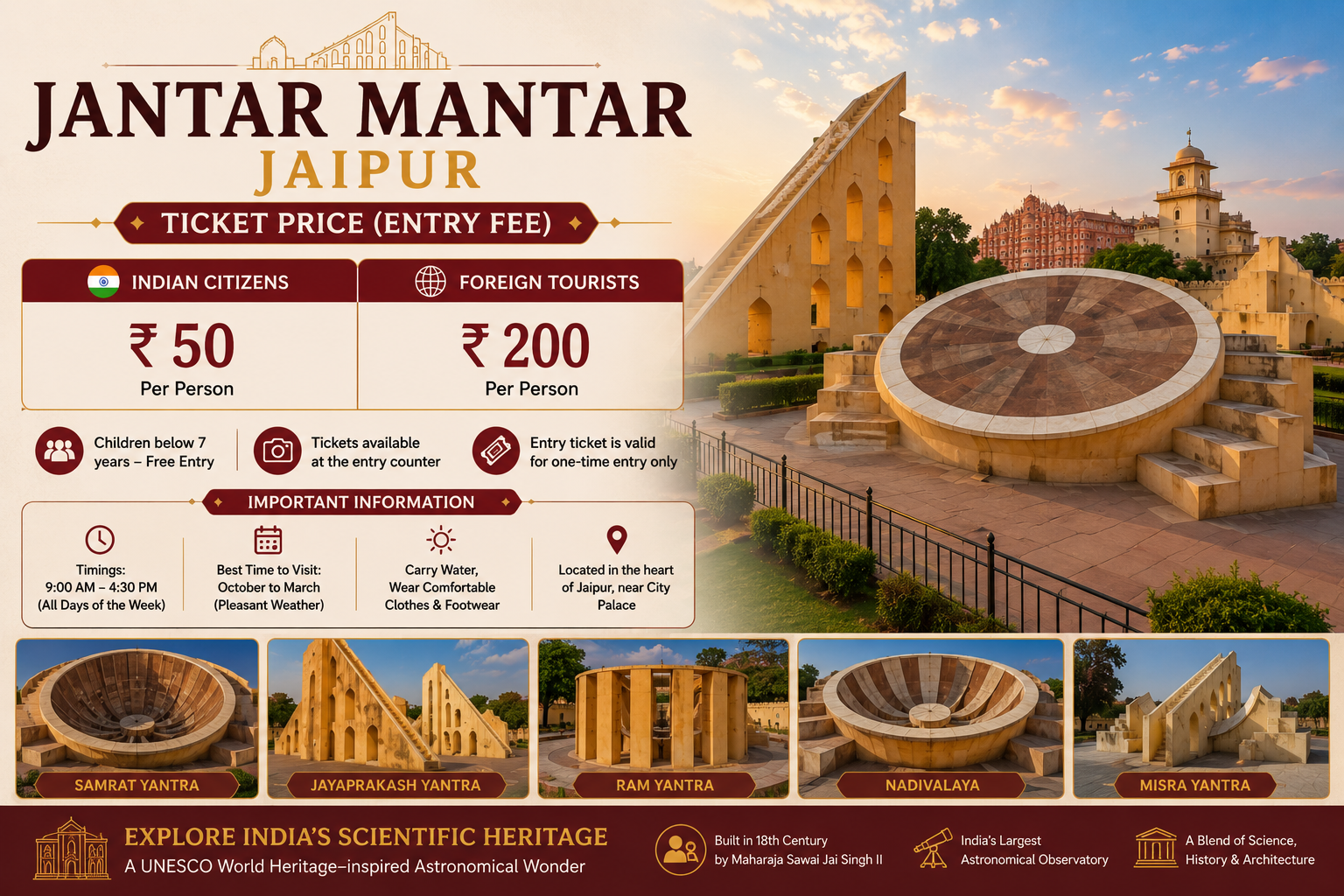
Jantar Mantar Jaipur Ticket Price (Entry Fee)
The jantar mantar jaipur ticket price is very reasonable, especially considering its UNESCO status. Tickets can be purchased at the entrance (near City Palace side) or online through the Rajasthan Tourism website.
| Visitor Category | Ticket Price (₹) | Notes |
|---|---|---|
| Indian Citizens | ₹50 per person | Adults |
| Indian Students (with ID) | ₹20 per person | Discounted rate |
| Foreign Tourists | ₹200 per person | Includes audio guide? (check at counter) |
| Foreign Students (with ID) | ₹100 per person | Discounted rate |
| Camera (Still) | ₹50 – ₹100 | Mobile phone photography is usually free |
| Video Camera | ₹200 – ₹500 | Professional filming may require a separate permit |
Where to buy jantar mantar tickets: You can purchase jantar mantar tickets at the main entrance (Gate 1 – near Jantar Mantar ticket counter, close to the City Palace complex). Online booking is available!
Pro tip: If you are also visiting City Palace Jaipur, which is right next door, you can buy a combined ticket (if offered) or visit both on the same day.
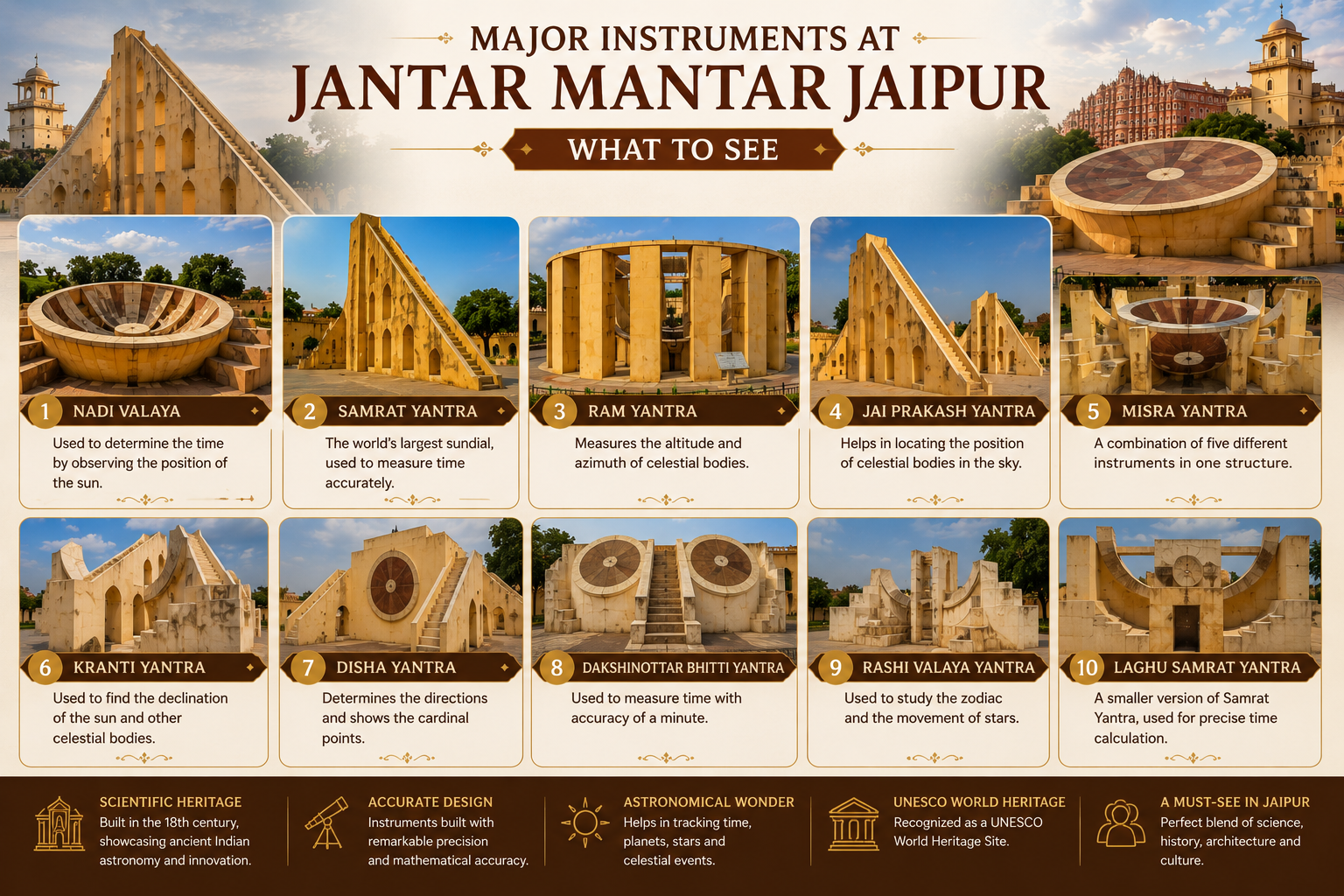
Major Instruments at Jantar Mantar Jaipur – What to See
The observatory has 19 major architectural instruments, each with a unique function. Here are the most important ones, perfect for jantar mantar jaipur photos.
1. Vrihat Smarat Yantra (The Giant Sundial)
Meaning: "Supreme Instrument"
Height: 27 metres (90 feet) – world's largest stone sundial
Function: Measures local time to an accuracy of 2 seconds
How it works: The massive triangular wall (ramp) points north, parallel to Earth's axis. The shadow of the wall falls on the curved marble scales on either side. The position of the shadow indicates the time.
Photo tip: Stand at the base looking up – the scale of this instrument is breathtaking. The best time for photos is early morning (9–10 AM) when the shadow is long and clear.
2. Laghu Smarat Yantra (The Small Sundial)
Meaning: "Small Supreme Instrument"
Function: Measures local time to an accuracy of 20 seconds
Description: A smaller version of the Vrihat Smarat Yantra, located nearby. It is easier to understand for first‑time visitors.
3. Ram Yantra
Function: Measures the altitude and azimuth (horizontal coordinates) of the Sun and planets.
Appearance: Two cylindrical structures (tube‑shaped), open to the sky, each with a central pole. Scales are inscribed inside the walls.
Unique fact: This instrument is found only in Jaipur and Delhi Jantar Mantars.
4. Jaya Prakash Yantra
Function: Determines the exact position of heavenly bodies (elevation, azimuth, hour angle).
Appearance: Two hemispherical bowls (concave) with graded marble slabs. The sky's inverted image is projected onto the bowl, and the movement of shadows on the slabs gives the coordinates.
Photo tip: The concave bowls make for excellent abstract photos – especially in late afternoon light.
5. Chakra Yantra
Function: A ring instrument that measures the coordinates and hour angle of the Sun.
Description: A large circular ring (almost 2 metres in diameter) mounted on a central pillar.
6. Digamsa Yantra
Function: Predicts sunrise and sunset timings.
Appearance: A pillar‑like structure in the middle of two concentric outer circles.
7. Nadivalaya
Function: Represents the two hemispheres of Earth.
Appearance: A pair of circular plates, one facing north, the other south.
8. Karnti Vritya
Function: Measures the solar sign of the Sun during daytime (i.e., which zodiac sign the Sun is currently in).
9. Unnatamsa Yantra (not always on display, but part of the collection)
Function: Measures the angular height of celestial bodies above the horizon.
How Instruments Work – Understanding the Science
Unlike modern telescopes, the instruments at Jantar Mantar in Jaipur are designed for naked‑eye observation. Here is the basic principle:
Sun dials (Vrihat Smarat Yantra, Laghu Smarat Yantra): The shadow of the triangular wall falls on a curved marble scale. The scale is divided into hours, minutes, and even seconds. By reading where the shadow falls, you can tell the local solar time.
Ram Yantra and Jaya Prakash Yantra: These use the principle of altitude-azimuth coordinates. The observer aligns the instrument with a celestial body and reads the inscribed scales.
All instruments are aligned with the Earth's axis and the cardinal directions, making them incredibly precise for their time.
Pro tip: Hire a guide at the entrance (₹300–500 for a 30‑45 minute explanation). Without a guide, the instruments look like abstract sculptures. With a guide, they come alive as sophisticated scientific tools.
Jantar Mantar Jaipur Photos – Best Photography Spots
For jantar mantar jaipur photos, the observatory is a dream – especially for architectural and abstract photographers.
| Photo Opportunity | Best Time | Tips |
|---|---|---|
| Vrihat Smarat Yantra (Giant Sundial) | 9:00–10:30 AM (morning) or 4:00–5:30 PM (afternoon) | Use a wide‑angle lens (16–24mm) to capture the entire structure. Stand at the base and shoot upward. |
| Ram Yantra (cylindrical structures) | Late afternoon (4–6 PM) | The circular shapes create beautiful shadows. Use a polarizing filter to enhance the sky. |
| Jaya Prakash Yantra (concave bowls) | Mid‑day (11 AM – 2 PM) – harsh light creates contrast | Climb the steps and look down into the bowl for abstract patterns. |
| Group photo in front of the sundial | Morning (9–10 AM) | The area around the base of the giant sundial is open; have someone stand at the lower end for scale. |
| Overall complex view | Early morning (9 AM) | Stand near the entrance facing the sundial – you can capture multiple instruments in one frame. |
Photography rules:
Mobile phones are allowed without extra fee.
Still cameras may require a ticket (₹50–100).
Tripods are usually not permitted without prior permission.
No flash is allowed, though it is rarely needed outdoors.
Is There a Night Jantar Mantar Jaipur Experience?
No, there is no night entry to Jantar Mantar. The monument closes at 7:00 PM. However, you can:
See the exterior from outside – The area around Jantar Mantar (near the City Palace road) is lit in the evening. You can walk by and see the silhouettes of the instruments.
Attend a light and sound show? – There is no regular light and sound show inside Jantar Mantar. The nearby City Palace and Amer Fort Jaipur have such shows. For astronomy, Jantar Mantar is strictly a daytime experience.
If you are an astronomy enthusiast, the best time to visit is during the day when you can actually see the shadows and understand the instrument functions. A night visit would not allow you to see the instruments properly.
How to Reach Jantar Mantar Jaipur
Jantar Mantar is located in the heart of the old city, very close to other major attractions.
| Starting Point | Distance | Travel Time | Best Mode | Approx Cost |
|---|---|---|---|---|
| Jaipur Railway Station | 4 km | 15–20 min | Auto‑rickshaw / Cab | ₹100–150 |
| Jaipur Airport (JAI) | 14 km | 30–40 min | Prepaid taxi / Uber | ₹300–400 |
| Sindhi Camp Bus Stand | 3.5 km | 15 min | Auto / Cycle rickshaw | ₹50–80 |
| Hawa Mahal | 500 m | 5–10 min walk | Walking | Free |
| City Palace | 200 m (adjacent) | 2–3 min walk | Walking | Free |
Exact address: Jantar Mantar, near City Palace, Gangori Bazaar, J.D.A. Market, Pink City, Jaipur, Rajasthan 302002.
Entry gate: The main entrance is near the City Palace ticket counter (Gate 1). You can also enter from the side facing the road.
Parking: There is no dedicated parking for Jantar Mantar. It is best to park your vehicle near Tripolia Bazaar or take an auto/taxi to the gate.
Nearby Tourist Places – Combine Your Visit
Jantar Mantar is surrounded by Jaipur's most famous sights. You can easily combine them in a half‑day or full‑day walking tour.
| Attraction | Distance | Why Visit |
|---|---|---|
| City Palace | 200 m (2 min walk) | Royal residence, museums, courtyards, and the famous four gates. |
| Hawa Mahal (Palace of Winds) | 500 m (5 min walk) | Iconic five‑storey facade with 953 windows – best for sunrise photos. |
| Govind Dev Ji Temple | Inside City Palace complex (300 m) | Royal Krishna temple – evening aarti at 6:45 PM. |
| Johari Bazaar | 500 m (walking) | Famous for Kundan jewellery, gemstones, and textiles. |
| Tripolia Bazaar | 300 m (walking) | Oldest market in Jaipur – lac bangles, brassware, iron crafts. |
| Albert Hall Museum | 2 km (10 min auto) | Oldest museum in Rajasthan – Egyptian mummy, night viewing available. |
Suggested Half‑Day Itinerary (Morning):
9:00 AM – Jantar Mantar (1 hour – hire a guide for 30 minutes)
10:30 AM – City Palace (2 hours)
12:30 PM – Lunch at a rooftop restaurant near Hawa Mahal
2:00 PM – Hawa Mahal exterior photo stop + Johari Bazaar shopping
4:00 PM – Optional: Albert Hall Museum
Best Time to Visit & Weather Tips
| Season | Months | Weather | Recommendation |
|---|---|---|---|
| Winter | October – March | Pleasant (10°C – 25°C) | ✅ Best time – early morning or late afternoon visit |
| Summer | April – June | Very hot (35°C – 45°C) | ⚠️ Visit only at opening time (9 AM) or late afternoon (4–6 PM) |
| Monsoon | July – September | Humid, occasional rain | 🟢 Good for fewer crowds; carry an umbrella |
Pro tip: Avoid visiting between 12 PM and 3 PM in summer – there is almost no shade in the observatory, and the marble surfaces reflect heat.
Essential Tips for Visiting Jantar Mantar
Hire a guide – The instruments are complex. A guide (₹300–500 for 30–45 minutes) will explain how each one works. You can also rent an audio guide (₹100–200) at the entrance.
Wear comfortable shoes – You will be walking on stone and marble surfaces for at least an hour.
Carry water – There are no shops inside the complex. Buy water before entering.
Sun protection – In summer, carry a hat, sunglasses, and sunscreen. In winter, early mornings can be chilly.
Allow at least 1.5 hours – A quick walk‑through takes 45 minutes, but a proper visit with a guide and photo stops needs 1.5–2 hours.
Combine with City Palace – Both are right next to each other. Plan to visit Jantar Mantar first (morning) and then City Palace (late morning to afternoon).
Book tickets online during peak season – During October–March, queues can be long. Use the online website to buy jantar mantar tickets in advance.
For photography – The best time for jantar mantar jaipur photos is the golden hour (early morning or late afternoon). The giant sundial casts dramatic shadows.
Frequently Asked Questions
Q1: What is the jantar mantar jaipur ticket price for Indians?
₹50 per person for adults. Indian students with ID pay ₹20.
Q2: What are jantar mantar jaipur timings?
Open from 9:00 AM to 7:00 PM daily. Last ticket issued at 6:30 PM. No weekly closure.
Q3: Is there a night jantar mantar jaipur experience?
No – the monument closes at 7:00 PM. You cannot enter after dark. However, the exterior is visible from the road, and the area is lit.
Q4: Where can I buy jantar mantar tickets?
At the entrance (Gate 1, near City Palace ticket counter) or online through the official website.
Q5: What is jantar mantar in jaipur famous for?
It is famous for the Vrihat Smarat Yantra – the world's largest stone sundial (27 metres / 90 feet tall). It is also a UNESCO World Heritage Site.
Q6: How many instruments are there in jantar mantar jaipur?
19 major architectural instruments, each designed for a specific astronomical measurement.
Q7: Is there a guide available at jantar mantar jaipur?
Yes – certified guides are available at the entrance. You can also rent an audio guide.
Q8: How much time is needed to see jantar mantar?
At least 1.5 hours – 30–45 minutes with a guide and another 30–45 minutes for exploring and taking photos.
Q9: Can I take jantar mantar jaipur photos with my phone?
Yes – mobile phone photography is allowed and free. Still cameras may require a small fee (₹50–100). Tripods are generally not permitted.
Q10: What is the best time to visit jantar mantar in jaipur?
October to March (winter season), early morning (9:00–10:30 AM) or late afternoon (4:00–6:00 PM).
Q11: Who built jantar mantar jaipur?
It was built by Maharaja Sawai Jai Singh II, the founder of Jaipur, in 1734.
Q12: Is jantar mantar jaipur a UNESCO World Heritage Site?
Yes – it was inscribed as a UNESCO World Heritage Site in 2010.
A Must-Visit for Curious Minds
Jantar Mantar Jaipur is not just a collection of old stones – it is a living testament to the scientific brilliance of 18th‑century India. Standing in the shadow of the world's largest stone sundial, watching the time tick away in seconds, you cannot help but marvel at the vision of Maharaja Sawai Jai Singh II.
Whether you are a history buff, an astronomy enthusiast, a photographer, or simply a curious traveler, Jantar Mantar will leave you inspired. Plan your visit between October and March, arrive early, hire a guide, and take your time to understand the instruments. And don't forget to capture those stunning jantar mantar jaipur photos – the giant sundial makes for one of the most iconic images of the Pink City.
Have you visited Jantar Mantar? Share your experience or your favourite instrument in the comments below!
For more travel inspiration, check out our other tours and guides:
Jhalana Leopard Safari Park Jaipur | Jim Corbett National Park vs Ranthambore National Park | Nahargarh Biological Park | Jeen Mata Mandir Sikar | Top 10 tourist places in jaipur | Govind Dev Ji Temple | Jaipur to Bhangarh Fort | Jaipur to Salasar Balaji Distance | Jaipur to Khatu Shyam Distance | Mehandipur balaji temple photos | Birla Mandir Jaipur | Amer Lake Boating | Jal Mahal Jaipur | Panna Meena Ka Kund | Jagat Shiromani Temple Amer | Elephant Park Jaipur (Hathi Gaon) | Elephant Safari in Jaipur | Kids Friendly Places to Visit in Jaipur