
Sheesh Mahal also known as Mirror Palace is the dazzling highlight of Amer Fort (Amber Fort) in Jaipur, India. Built under Maharaja Man Singh I in the late 1500s and completed by 1727 AD, this ornately mirrored hall (Jai Mandir) allowed royal women to enjoy candlelit starlit views indoors.
Amber Fort is a UNESCO World Heritage Site (Hill Forts of Rajasthan, 2013) and Sheesh Mahal is its most famous interior, famed for thousands of tiny mirrors imported from Belgium. This guide covers Sheesh Mahal’s history and architecture, its role in Amer Fort, practical visitor info (hours, tickets, tours, night show, etc.), nearby attractions (with distances), lodging options, and travel tips. A timeline of key dates is provided below.
History and Architecture
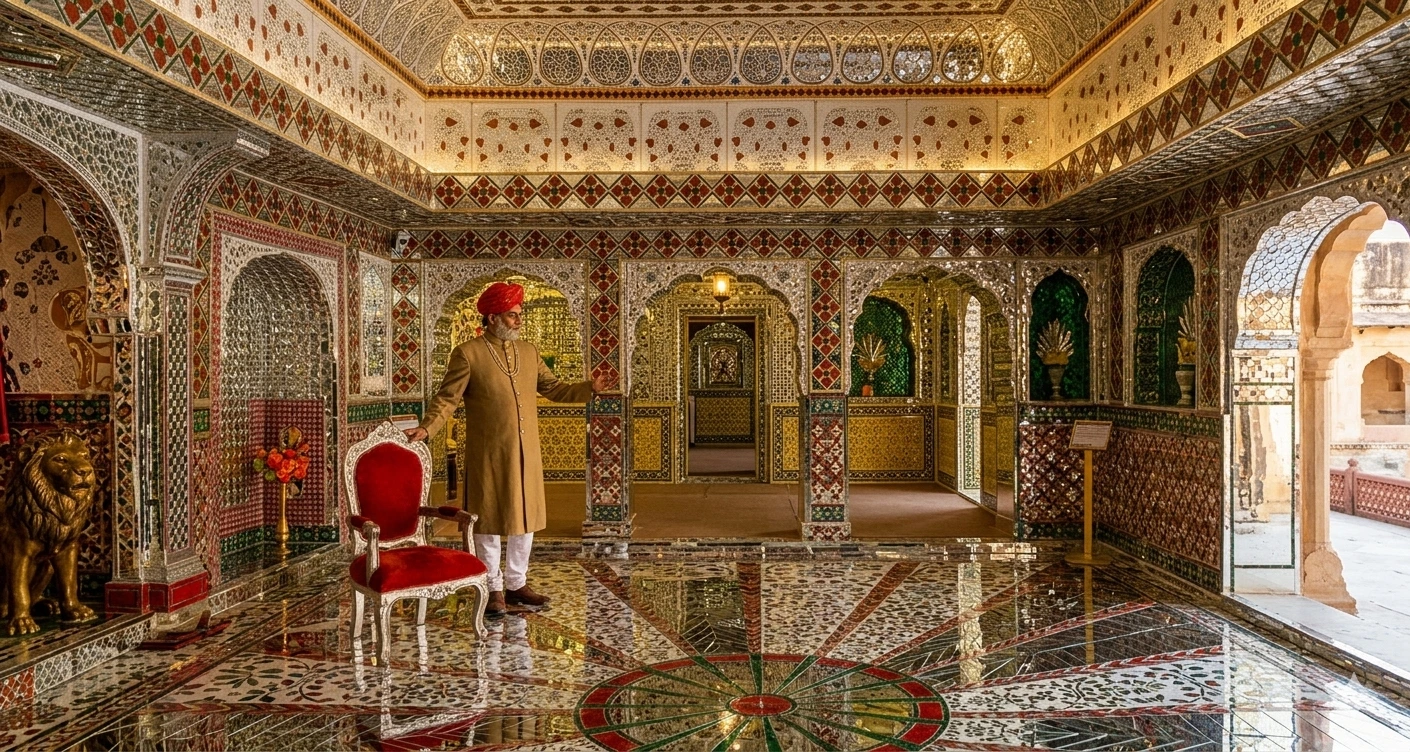
Sheesh Mahal sits in Amer Fort’s third courtyard (Jai Mandir), facing the pleasure garden. Its name (Hindi for “mirror palace”) reflects its interior: walls and ceilings encrusted with thousands of tiny, convex mirrors and colored glass tiles. Legend holds Maharaja Man Singh I (r. 1589–1614) built it so his queen could gaze at the stars indoors by candlelight. In reality, construction began in Man Singh’s time and was finished by Sawai Jai Singh II in 1727.
The design blends Rajput and Mughal styles: white marble reliefs, pietra dura inlay and floral motifs surround the mirror mosaics. It even includes a carved “magic flower” panel at a pillar base, a playful optical trick revealing different images from each corner.
Over centuries the hall fell into ruin, but recent conservation by the Archaeological Survey of India and Amer Dev. & Management Authority has restored much of the mirrorwork. (Modern barriers now protect the delicate 17th-c. mosaics from visitors.)
Today the small hall is entered through gilded sandalwood doors, and under torchlight its mirrors multiply even a single flame into a starry “jewel box” effect.
Significance
Sheesh Mahal is the crowning jewel of Amber Fort’s private quarters. The fort itself (Amer Palace) spans 4 courtyards, blending Hindu and Islamic design. Sheesh Mahal (also called Jai Mandir) was the king’s private audience chamber, intended to impress guests and comfort royal ladies. Its intricate mirror-work exemplifies the international links of the era: glass and mirrors were reportedly imported from Belgium and cut by skilled artisans.
The hall’s reflective magic—thousands of tiny mirrors glittering under lamplight—has long made it one of India’s most photographed interiors. Because Amber Fort (Amer Fort) is part of the UNESCO-listed Hill Forts of Rajasthan (2013), Sheesh Mahal’s conservation is tightly linked to preserving the palace’s overall heritage.
Entry Fee and Timings of Sheesh Mahal
The entry fee to visit Sheesh Mahal Amer Fort is generally included in the Amer Fort ticket, costing around INR 100 for Indian visitors and INR 500 for foreign tourists (rates may vary, so checking the latest ticket prices before visiting is recommended).
Sheesh Mahal Jaipur can be explored during Amer Fort visiting hours, usually from 7:00 AM to 9:00 PM, allowing visitors to experience both the daytime grandeur and the magical evening atmosphere.
Best Time to Visit Sheesh Mahal
The best time to visit Sheesh Mahal Amber Fort is during the winter months, from November to February, when Jaipur enjoys pleasant weather ideal for exploring the fort complex. Early mornings and sunset hours offer beautiful lighting for photography and a more comfortable sightseeing experience.
Things to Do at Sheesh Mahal
Admire the dazzling mirror work of Amer Fort Sheesh Mahal, where thousands of tiny mirrors create a mesmerizing play of light. Explore the palace interiors, learn about Rajput craftsmanship, capture stunning photos, and enjoy the romantic royal ambiance that makes this hall so famous.
#Tip: Hire a best tour guide in Jaipur to uncover fascinating stories, hidden details, and the history behind the intricate mirror mosaics of the Mahal and Amer Fort.
Don’t miss the Amer Fort Light and Sound Show in the evening, and if possible, experience Sheesh Mahal at night, when the illuminated fort looks truly magical.
Visiting Sheesh Mahal
Location & Layout: Sheesh Mahal lies inside Amer Fort (also called Amber Palace) about 11 km north of Jaipur city centre. Visitors pass through the main gates (Suraj Pol, Ganesh Pol) and Diwan-e-Am halls before reaching the third courtyard, where the mirrored Jai Mandir stands to the left. (On top of Jai Mandir is Jas Mandir with alabaster inlay, and opposite lies the cooled Sukh Niwas garden pavilion.)
Opening Hours: The Amber Fort complex is generally open from about 8–9 AM until evening (roughly 5–6 PM). (Hours vary slightly by season.) A sound-and-light show is held nightly on the ramparts (see below) and requires separate tickets.
Entry Fee (Daytime): As of 2026, Amber Fort entry costs approximately ₹200 for Indian adults and ₹1,000 for foreign tourists. (Children under 15 are generally free.) Concessions exist (Indian students ≈₹50, foreign students ≈₹150). Entry fee includes access to all interiors, including Sheesh Mahal. (There used to be a small camera fee; currently most visitors use hand cameras or phones at no extra charge.)
Sound & Light Show: Evenings feature a sound-and-light presentation about Amer Fort’s history. Shows run seasonally (e.g. Oct–Feb at ~6:30/7:30 PM, March–Sep around 7–8:30 PM). Tickets are sold separately (roughly ₹200/₹100 for English/Hindi narrations). The show takes place outside, with the illuminated fort as backdrop.
Guided Tours: Licensed guides are available at the fort entrance for a modest fee and can explain the Sheesh Mahal’s art and stories. Audio tours or guidebooks also cover the highlights. Self-guided visits are common: signage and pamphlets note key features.
Photography Rules: Casual photography is allowed (no extra charge) but be mindful: no flash or tripods (to protect frescoes and mirrors), and drones are prohibited without permission. (Note: ropes and glass screens keep visitors at a short distance inside Sheesh Mahal.)
Accessibility & Safety: Amer Fort is on a hilltop. Most visitors climb cobbled ramps or hire a jeep/elephant ride (see below) from the base. The site has many stairs; wheelchair access is very limited. Carry water and sun protection (it gets hot and dry). Beware of loose stones and monkeys; keep belongings secure.
How to Reach Sheesh Mahal (Amber Fort)
The fort is about a 40-minute drive from central Jaipur. Buses (RSRTC) to Amer Fort depart from the city’s Ajmeri Gate or MI Road terminals. Alternatively, hire a taxi, auto-rickshaw or app cab directly to the Amer Fort parking area. If driving, park in the lot at the base of the hill (historic elephant rides depart here). From the parking area (called Hawa Mahal Parking or Jaigarh Gate), you can walk up a stone path (~15–20 mins) to the fort entrance, or pay for a short jeep or elephant (uphill only, mornings) ascent. Elephant rides (subject to availability/animal welfare rules) currently cost around ₹1,000 per pair (often more). Jeps charge ~₹450–500 round-trip for up to 5 people.
Nearby Attractions Around Amer Fort, Jaipur
When you visit the majestic Amer Fort, your journey doesn’t end there. The surrounding region is filled with iconic landmarks, scenic viewpoints, and royal heritage sites that can easily turn your trip into a full-day or even multi-day Jaipur itinerary. Here’s a carefully curated list of the best nearby attractions, along with why they’re worth visiting and how much time you should plan.
Jaigarh Fort (2–4 km | 2–3 Hours)
Located just above Amer Fort, Jaigarh Fort is a must-visit for history lovers. It is famous for housing the world’s largest cannon on wheels, the Jaivana Cannon, which symbolizes the military strength of the Rajput rulers. The fort is connected to Amer Fort through an underground tunnel, making it historically significant for defense strategies. Visitors can enjoy panoramic views of the Aravalli hills and Amer complex, making it a perfect spot for photography and exploration.
Nahargarh Fort (~10 km | 2–3 Hours)
Perched on the Aravalli hills, Nahargarh Fort offers one of the best sunset views in Jaipur. Built by the Kachwaha rulers, this fort once served as a defensive structure for the city. Today, it is known for its peaceful environment, scenic viewpoints, and café experiences. It’s an ideal place to unwind after exploring Amer Fort and enjoy breathtaking views of the Pink City.
Maota Lake (Amer Maota)
A scenic lake just below the fort offering calm views, and great photo spots, especially at sunrise and sunset. Ideal for a short relaxing stop after fort exploration.
Elephant Safari Jaipur
Experience traditional elephant interactions and village-style activities near Amer. Ethical elephant park now focus on walking, feeding, and learning about elephant care.
Jagat Shiromani Temple
A beautiful 16th-century Jagat Shiromani temple known for its intricate carvings and peaceful atmosphere. Dedicated to Lord Krishna, it’s a must-visit for spiritual and heritage lovers.
Jal Mahal (~8 km | 30–60 Minutes)
Jal Mahal, also known as the Water Palace, sits beautifully in the middle of Man Sagar Lake. While entry inside the palace is restricted, the view from the lakeside is truly mesmerizing—especially during sunrise and sunset. It’s one of the most photographed spots in Jaipur and a perfect quick stop for nature lovers and photographers.
City Palace (~12 km | 2–3 Hours)
Located in the heart of Jaipur, the City Palace is a grand complex showcasing royal heritage and architecture. It houses museums displaying royal costumes, weapons, textiles, and artifacts. The beautifully designed courtyards and gates make it a must-visit for anyone interested in Rajasthan’s regal history. Plan at least a couple of hours to explore this iconic attraction properly.
Hawa Mahal (~13 km | 30–60 Minutes)
The famous “Palace of Winds” is one of Jaipur’s most recognizable landmarks. Built with pink sandstone, it features 953 small windows (jharokhas) designed to allow royal women to observe street life while staying hidden. It’s perfect for a quick visit and photography stop, especially in the early morning when the sunlight enhances its beauty.
Many visitors combine Amer Fort with nearby Amber town temples (Sila Devi Temple), Nahargarh Palace, or the reconstructed Maota Lake gardens. Each of the above is within a short drive and worth a visit if time allows.
Accommodation Options
Staying overnight near Amer Fort spans all budgets. Luxury: Jaipur’s famous heritage hotels are 10–15 km away (Rambagh Palace, Fairmont Jaipur, Oberoi Rajvilas). For a royal experience close to Amer, options include Samode Haveli (a 17th-c. mansion in Amer town) or luxurious resorts on the Jaipur-Amber highway.
Mid-range: Several heritage guesthouses and 3★ hotels cluster along Amer Road and in Jaipur’s old city (e.g. Amer View Hotel, Hotel Kalyan). Budget: Basic guesthouses and hostels (₹500–1,500/night) are available in Amber village and Jaipur; many travellers stay near the city centre (15–20 min away) for more choices and commute to Amer Fort for sightseeing. (Advance booking is wise in peak season.)
Suggested Itineraries
- Half-Day Visit: Morning is ideal for Amer Fort. Start at Suraj Pol entrance, explore Jaleb Chowk and Diwan-e-Am, then Sheikh Mahal and Sukh Niwas. Descend by 2 PM before the midday heat. In late afternoon, catch the sound-and-light show if interested.
- Full-Day Jaipur: Combine Amer Fort in the first half with City Palace, Jantar Mantar, Hawa Mahal and local bazaars in the afternoon.
- Night Tour: Amer Fort’s Light & Sound show (English/Hindi narrations) runs nightly (tickets sold at the fort). After the show, the fort is beautifully floodlit. Tip: take photos of the illuminated walls from the base area or pay a last-entry fee if available.
Tips for Visitors
- Dress Comfortably: Wear sturdy shoes (lots of walking/stairs) and lightweight clothing (temperatures can exceed 40 °C in summer). Carry a hat, sunscreen and water bottle. Modest attire is appreciated (and needed if visiting on-site temples).
- Beat the Crowds: Arrive early (8–9 AM) to enjoy Sheesh Mahal in relative quiet and cooler air. Midday (noon–3 PM) can be very hot and crowded. Late afternoon is pleasant for photos.
- Elephant Rides: Although an iconic option, note that elephant rides are limited to the morning and have drawn animal welfare criticism. You may prefer the jeep or walking (the climb is scenic and not too steep).
- Local Customs: Remove shoes at temple entrances (Ganesh Pol has a small shrine). Photography of religious ceremonies or priests may require permission.
- Food and Amenities: Limited eateries exist near the fort gate (tea, snacks). For full meals, plan to eat in Jaipur city. Restrooms are available at the ticket area and inside the fort.
- Stay Alert: Monkeys roam Amer Fort – avoid teasing them or leaving bags unattended. Keep a hold on small items near the crowds.
FAQ
Is photography allowed inside Sheesh Mahal?
Yes, still photography with hand-held cameras/phones is permitted. Flash is discouraged to protect the artwork. (Tripods and drones are not allowed.) Protective glass now keeps visitors at a short distance from the mirrored walls, so you can safely enjoy taking pictures.
When is the best time to visit Sheesh Mahal?
The cool months (October–March) are most comfortable. Early morning or late afternoon visits avoid the crowds and heat. For a truly unique view, attend the fort’s full-moon night tour (available through ASI advance booking on select dates), when the Mirror Palace can be lit by moonlight.
Can we see Sheesh Mahal at night?
The Mirror Palace is included in Amer Fort’s evening Light & Sound show. Although you cannot walk inside the fort after normal hours, the show illuminates the exterior and temple area. The interior mirrors glitter during the show, but access to Sheesh Mahal’s interior is not permitted at night.
Are guided tours and maps available?
Yes – official guides (English/Hindi) can be hired at the entrance, and audioguides or brochures are provided. Self-guided tour apps and maps of Amer Fort (highlighting Sheesh Mahal) are also widely available online.
Is Amber Fort wheelchair accessible?
Unfortunately, most of Amer Fort (including the mirror hall) involves steep ramps and stairs. There are no lifts, and the temples require shoe removal on uneven floors. Visitors with mobility issues can enjoy the lower courtyards and Light & Sound show from the base.
Is it safe to ride elephants?
Elephant riding are allowed (morning only, booked at base gate). Current welfare standards have improved, but many travellers choose jeeps or walking instead. If you ride, ensure the handler provides water and that you pay a fair tip (₹50–100) after the ascent.
Sources
We have drawn on official tourism resources and expert guides: India sites for Amber/Sheesh Mahal; UNESCO documentation of Amer Fort; Jaipur-based travel guides, news and historical descriptions. These sources underpin the detailed history, visitor facts, and practical advice above.